At What Number of Employees Should a Growing Business Hire an HR Consultant or Start Outsourcing HR?
Quick Answer:
A growing business should usually consider hiring an HR consultant or outsourcing HR somewhere between 10 and 25 employees, especially if the owner or office manager is already handling payroll questions, hiring issues, employee complaints, handbook updates, benefits, and compliance tasks without formal HR training.
By the time a company reaches 25 to 50 employees, HR support becomes much harder to ignore. At that size, the business usually has more managers, more scheduling problems, more pay questions, more employee relations issues, and more legal exposure. Many businesses do not need a full-time HR employee yet, but they do need professional HR backup.
Around 40 to 50 employees, a dedicated HR function becomes much more important. That may mean an internal HR hire, an outsourced HR provider, a PEO, or a hybrid setup. The right answer depends less on a magic headcount number and more on how much employee complexity the business is already carrying.
The Better Question Is Not “How Many Employees?”
Most business owners want a clean number.
Five employees? Ten? Twenty-five? Fifty?
It would be nice if HR worked that way.
It does not.
A 12-person construction company with field crews, overtime, safety issues, workers’ comp claims, and seasonal layoffs may need HR help sooner than a 30-person remote agency with salaried employees and low turnover. A restaurant with 18 people can have more HR friction than a professional services firm with 45. A family-owned business with three relatives and seven nonfamily employees can create more drama than a much larger company with clear managers and systems.
Headcount matters.
But friction matters more.
The real question is this: are employee issues starting to pull the owner away from running the business?
If the answer is yes, it is probably time to bring in HR support.
What HR Actually Handles
A lot of small business owners think HR means hiring and firing.
That is part of it.
Barely.
Human resources work includes recruiting, onboarding, payroll coordination, benefits administration, employee handbooks, workplace policies, performance issues, leave requests, discipline, compliance, harassment complaints, wage and hour questions, employee records, training, and manager support.
In other words, HR is where people problems become business risk.
That is why it gets messy so fast. A payroll mistake is not just a payroll mistake if it turns into a wage claim. A bad manager conversation is not just a bad conversation if an employee files a harassment complaint. A casual decision to “let one person work from home for a while” can become a consistency issue when the next employee asks for the same thing.
HR is not there to make the company feel corporate.
It is there to keep people’s decisions from becoming expensive improvisation.
Operational Risk Map: When to Trigger HR Support
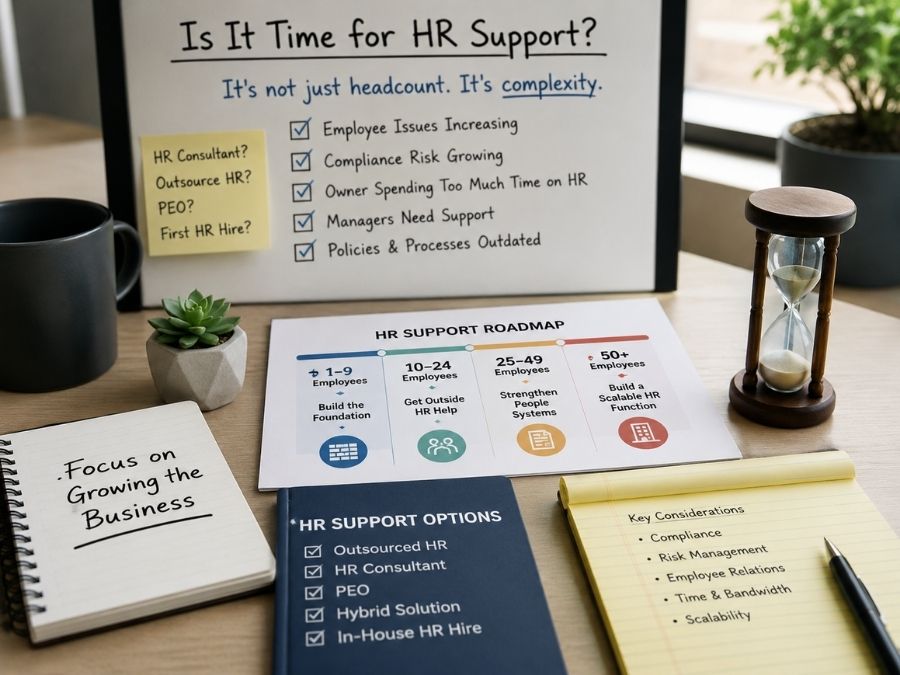
| Business Size | Core HR Focus | Primary Compliance & Hidden Risk | Recommended Model |
|---|---|---|---|
| 1 to 9 employees | Clean foundational files, including offer letters, I-9 compliance, and basic time tracking. | Assuming handshake verbal deals are enough; misclassifying early staff. | Owner-Managed + Occasional Consultant Review |
| 10 to 24 employees | Standardization of basic policies, including hiring, calling out, and consistent pay. | Employee administrative issues start eating 5+ hours of the owner’s week. | Outsourced HR Support / On-demand Advisor |
| 25 to 49 employees | Manager training, clear handbooks, and structured leave tracking. | Splitting HR randomly between untrained managers, breeding inconsistency. | Ongoing Outsourced HR / Specialized Consultant |
| 50 employees | Comprehensive benefits compliance and formal request handling. | The Compliance Shift: Crossing the threshold into major federal mandates. | Full HR Outsourcing, PEO, or First Internal Hire |
| 75 to 100+ employees | Long-term talent retention strategy, cultural oversight, and formal recruiting pipelines. | Operational fragmentation; managers operating with completely different rules. | Dedicated Internal HR Generalist or Mature Hybrid PEO |
This table is not a law.
It is a warning light.
If your business has high turnover, field crews, multiple states, safety risk, commission pay, seasonal labor, or constant scheduling issues, move yourself one category higher. Complexity counts just as much as headcount.
The Headcount Guide: When HR Support Starts Making Sense
There is no universal law that says, “At this exact number, hire HR.”
But there are clear stages where the risk changes.
1 to 9 Employees: Keep It Simple, But Do Not Wing It
At this stage, the owner usually handles everything. Hiring, payroll, scheduling, discipline, complaints, paperwork, and benefits questions all land on the same desk.
That may be fine for a while.
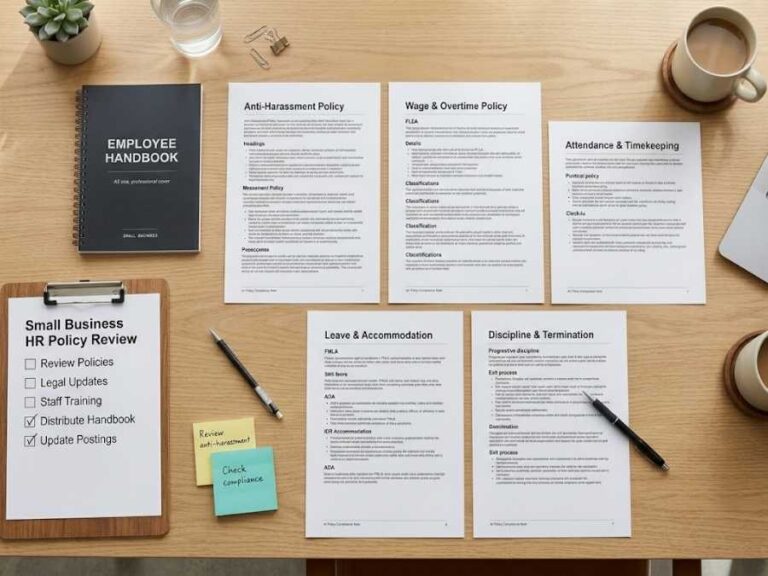
But even a very small business should have the basics in place: offer letters, I-9 procedures, payroll classifications, timekeeping rules, anti-harassment expectations, a basic attendance policy, and clean employee files.
This is the stage where a one-time HR consultant review can be useful. You may not need ongoing HR outsourcing yet. But you probably do need someone to check whether your foundation is crooked before you build more weight on top of it.
A small mistake at five employees is easier to fix than the same mistake repeated across 30 people.
10 to 24 Employees: Get Outside HR Help Before the Owner Becomes the HR Department
This is the range where HR starts showing up in the owner’s day, whether they invited it or not.
Someone wants a raise. Someone says a supervisor is playing favorites. Someone asks about maternity leave. Someone complains about another employee’s behavior. Someone forgets to clock in. Someone quits and asks for their final paycheck immediately. Someone wants to know why their coworker gets a different schedule.
None of these issues feels massive by itself.
Together, they eat the week.
At 10 to 24 employees, most businesses should strongly consider an HR consultant, outsourced HR support, or a payroll provider with real HR advisory services. Not because the business is huge. Because the owner is no longer managing a handful of people casually. They are managing a workforce.
That is different.
25 to 49 Employees: Outsourced HR Becomes More Than a Nice Idea
This is the danger zone for many growing businesses.
You are big enough to have real employee complexity, but often not big enough to justify a full-time HR hire. So HR tasks get split between the owner, bookkeeper, office manager, operations manager, and whoever is “good with people.”
That setup works until it does not.
At this size, the business needs stronger systems: a real employee handbook, manager training, standardized hiring and onboarding, leave procedures, disciplinary documentation, pay practices, benefits administration, and compliance calendars. If the company has multiple locations, remote workers, field employees, or high turnover, the need gets sharper.
Outsourced HR can make a lot of sense here. The business gets professional guidance without carrying a full-time HR salary. That support may include handbook work, policy updates, employee relations advice, compliance help, recruiting support, benefits coordination, and manager coaching.
This is where many companies should stop asking, “Can we afford HR?”
The better question is, “Can we afford not to have it?”
50 Employees: The Compliance Temperature Changes
Fifty employees is not just a round number. It is a serious threshold.
Once a business reaches 50 full-time employees or full-time equivalents, several compliance issues may become more significant, including Affordable Care Act employer shared responsibility rules and Family and Medical Leave Act coverage if other requirements are met. The details matter, and businesses should confirm how the rules apply to their exact workforce.
This is not the time to be guessing.
With 50 employees, a company should have professional HR support in place. That may mean outsourcing HR, hiring an internal HR generalist, working with a PEO, or using a hybrid model. What usually does not work is continuing to treat HR as a side task handled between payroll runs.
The business has crossed into a different level of responsibility.
The paperwork, policies, benefits, employee relations, and compliance obligations need to catch up.
75 to 100 Employees: You Probably Need a Dedicated HR Function
By the time a business reaches 75 to 100 employees, HR should not be living entirely in the owner’s head, the bookkeeper’s inbox, or the office manager’s spare time.
At this size, the business usually needs someone clearly accountable for HR. That might be an internal HR manager supported by outside consultants. It might be an outsourced HR team with a designated contact. It might be a PEO arrangement. But the function needs ownership.
Employees will expect structure. Managers will need coaching. Benefits will become more complex. Documentation will matter more. Hiring will become more frequent. Employee complaints will become more likely simply because there are more people, more relationships, and more chances for something to go wrong.
A business with 100 employees and no real HR structure is usually not lean.
It is exposed.
The Practical HR Trigger List
Headcount is useful, but these warning signs are often more honest.
If any of these are happening, it may be time to hire an HR consultant or outsource HR:
The owner is spending more than five hours a week on employee issues
Managers are asking HR questions nobody can answer confidently
Employees are complaining about inconsistent treatment
Payroll corrections are happening regularly
Hiring is constant, rushed, or disorganized
Turnover is rising
The company has no current employee handbook
Employee files are incomplete or scattered
Nobody knows what to do with leave or accommodation requests
Supervisors are disciplining employees differently
Benefits questions are overwhelming the office manager
The company is expanding into another state
Someone has already threatened to call a lawyer, the labor department, or the EEOC
That last one is not a sign to start thinking about HR.
That is a sign you are already late.
The “Owner Is the HR Department” Problem
In the beginning, the owner is usually the HR department.
That makes sense.
The owner knows the culture, knows the people, and wants to keep decisions close. But over time, this becomes a bottleneck. Employees do not always feel comfortable bringing problems to the owner, especially if the owner is also their boss, the payroll decision-maker, and the person who signs off on raises.
Managers also need someone to call before they make a bad decision.
Without HR support, managers improvise. One manager writes people up for being five minutes late. Another lets the same issue slide for months. One supervisor approves flexible scheduling. Another denies it. One employee gets a second chance. Another gets fired.
That inconsistency is where claims grow.
Not always because the company meant to do anything wrong.
Often because nobody was keeping the rules straight.
HR Consultant, Outsourced HR, PEO, or In-House Hire?
These options are not the same. A growing business should understand the difference before buying something that sounds good in a sales call.
🧩 Choosing Your HR Infrastructure
The HR Consultant: Project-Based
Best for executing discrete, high-impact fixes. Call them when you need to write a brand-new handbook, run an investigation, audit messy payroll files, or train your managers.
The Outsourced HR Provider: Fractional Department
Provides an ongoing, monthly safety net. They give you compliance calendars, policy templates, and phone support for daily employee relations issues without the weight of an internal salary.
The PEO: Co-Employment Model
A comprehensive model where the vendor may handle payroll, tax reporting, workers’ compensation, benefits administration, and HR support through a shared employment structure. A PEO may also help smaller employers access broader benefits options, but the business should review fees, service limits, and control carefully.
The In-House Hire: The Ground-Floor Generalist
Becomes necessary when internal friction is constant. Bring a generalist inside your walls when your culture needs daily management, hiring is constant, or you hit the 50 to 75 employee range with growing complexity.
This is where owners need to be honest about cash flow and friction.
If the problem is occasional policy cleanup, hire a consultant. If the problem is steady employee relations, use outsourced HR. If the problem is payroll, benefits, compliance, and infrastructure, look at a PEO. If the problem is daily internal people management, it may be time for an in-house HR hire.
Buying the wrong HR model is like buying the wrong tool.
It may be expensive and still not fix the problem.
HR Support by Business Stage
| Business Size | What Usually Works | What Usually Goes Wrong |
|---|---|---|
| 1 to 9 employees | Basic HR setup, payroll compliance, offer letters, simple policies, occasional consultant review | The owner assumes verbal agreements are enough |
| 10 to 24 employees | HR consultant or outsourced HR support for policies, hiring, discipline, and compliance questions | Employee issues start eating the owner’s week |
| 25 to 49 employees | Ongoing outsourced HR, handbook, manager training, benefits support, employee relations process | HR gets dumped on the office manager with no training |
| Around 50 employees | Strong outsourced HR, PEO, or first HR hire depending on complexity | Compliance thresholds get missed |
| 75 to 100 employees | Dedicated HR function, internal HR plus outside specialist support if needed | People decisions become inconsistent across managers |
| 100+ employees | Formal HR department or mature outsourced HR structure | HR stays reactive instead of strategic |
This is not a rigid chart.
It is a second warning system.
If your business is dealing with high turnover, field employees, multiple states, safety risk, commission pay, seasonal labor, or frequent scheduling issues, move yourself one category higher.
The Cost Question: Is Outsourcing HR Cheaper Than Hiring?
Often, yes.
At least at first.
Hiring a full-time HR professional means salary, payroll taxes, benefits, training, software, and management. Outsourcing HR may give the company access to experienced support without the full cost of a dedicated employee.
But cheaper is not the only point.
The real value is avoiding bad decisions. A mishandled termination, wage claim, harassment complaint, misclassified employee, or sloppy leave decision can cost far more than a year of outsourced HR support.
A good HR consultant does not just answer questions.
They help owners ask better ones before they create a problem.
When You Should Hire In-House Instead of Outsourcing
Outsourcing works well when the business needs expertise, tools, and guidance.
But at some point, the company may need someone inside the business who understands the culture, sees the patterns, knows the managers, and can handle employee issues in real time.
That point usually arrives when:
Hiring is constant
Employee relations issues are frequent
Managers need regular coaching
The company has multiple departments or locations
Benefits administration is complex
The owner is no longer the right person to receive complaints
Employees need a trusted internal contact
The company is approaching 75 to 100 employees
Outsourced HR can still support an internal HR person. In fact, that is often the best setup. The internal person handles day-to-day work, while outside specialists help with legal updates, handbook reviews, investigations, compensation, benefits, or difficult employee relations issues.
Good HR is rarely all-or-nothing.
It is layered.
The Mistake: Waiting Until Something Blows Up
A lot of business owners wait until there is a serious issue before they call HR.
An employee complaint.
A wage dispute.
A manager accused of harassment.
A messy firing.
A Department of Labor letter.
A lawyer’s email.
By then, the work is harder. The documentation may be thin. The manager may have already said the wrong thing. The employee may already feel ignored or retaliated against. HR can still help, but now it is a cleanup.
Cleanup is always more expensive than prevention.
Hiring an HR consultant before a crisis does not mean the business is paranoid. It means the owner understands that employees are not just labor. They are a legal, financial, cultural, and operational responsibility.
That responsibility grows with headcount.
The Bottom Line: Start Earlier Than You Think
A growing business should usually bring in some form of HR support by 10 to 25 employees, especially if the owner is already handling employee issues by instinct instead of process. By 25 to 50 employees, outsourced HR or a regular consultant relationship becomes much more practical. Around 50 employees, professional HR support is no longer optional for most companies that want to avoid compliance surprises. By 75 to 100 employees, the business usually needs a dedicated HR function.
There is no trophy for doing HR the hard way.
Small businesses often wait because they think HR is overhead. But good HR is not just paperwork. It is risk control, manager support, employee trust, better hiring, cleaner documentation, and fewer expensive surprises.
That is not corporate bloat.
That is grown-up infrastructure.
Next Step for Owners
Look at your last 90 days.
How many employee issues landed on the owner’s desk? How many payroll corrections happened? How many hiring problems, attendance issues, complaints, leave questions, or awkward termination decisions came up?
If the answer is “more than a few,” you are already doing HR.
The only question is whether you are doing it with professional support or making it up as you go.