What Are the Biggest Mistakes Employees Make During Open Enrollment, and How Do I Help Them Avoid Them?
Quick Answer:
The biggest mistakes employees make during open enrollment are choosing the cheapest plan without understanding the real cost, ignoring provider networks, skipping prescription drug checks, forgetting to update dependents, underusing tax-advantaged accounts, blindly repeating last year’s choices, and waiting until the final deadline to ask questions.
Most of these mistakes are not because employees are careless.
They happen because health benefits are confusing, the language is dense, and people usually make decisions while juggling work, family, bills, and whatever else is happening in their lives. A business can help by communicating early, explaining benefits in plain English, giving employees comparison tools, holding short Q&A sessions, and reminding people what can and cannot be changed after open enrollment closes.
Open enrollment is not just an administrative deadline.
It is one of the few times each year when employees can make decisions that affect their medical costs, family coverage, paycheck deductions, tax savings, and financial stress for the next 12 months.
Why Open Enrollment Goes Wrong So Often
Open enrollment should be simple.
Here are the plans. Pick one. Done.
Except that is not how employees experience it.
They see premiums, deductibles, copays, coinsurance, provider networks, out-of-pocket maximums, prescription tiers, HSA eligibility, FSA rules, dependent coverage, voluntary benefits, and deadlines. Half the terms sound similar. The other half feels designed by people who enjoy making simple decisions harder.
So employees do what busy people do.
They guess.
They keep the same plan because it feels safer. They choose the lowest paycheck deduction because it looks cheaper. They ignore the network until their doctor is suddenly out of network. They forget about a medication until January. They missed the FSA election because they meant to come back to it later.
And then benefits become an HR problem.
Not because HR did anything wrong.
Because open enrollment confusion always lands somewhere.
The Tuesday Morning Version of Open Enrollment
Here is the version that happens in real offices.
An employee walks into the office two weeks after enrollment closes. They are annoyed. Their spouse is not listed on the plan. Their child’s medication is suddenly more expensive. Their doctor is not in network. They thought the deductible was lower. They thought the FSA rolled over automatically. They thought they had dental.
The owner or office manager says, “But we sent the packet.”
The employee says, “I did not understand the packet.”
Both things may be true.
That is the problem.
Sending information is not the same as helping employees make a decision.
A stack of PDFs does not count as communication if nobody understands what they mean.
Mistake 1: Choosing the Cheapest Premium Without Looking at Total Cost
This is the most common mistake.
Employees look at the premium first because it comes out of their paycheck. That makes sense. It is visible. It is immediate. It feels like the price of the plan.
But the premium is only one piece of the cost.
A plan with a low monthly premium may have a higher deductible, higher out-of-pocket exposure, higher prescription costs, or a tighter network. That may be fine for some employees. It may be a disaster for someone who expects regular care, has children, uses expensive medication, or has a planned procedure coming up.
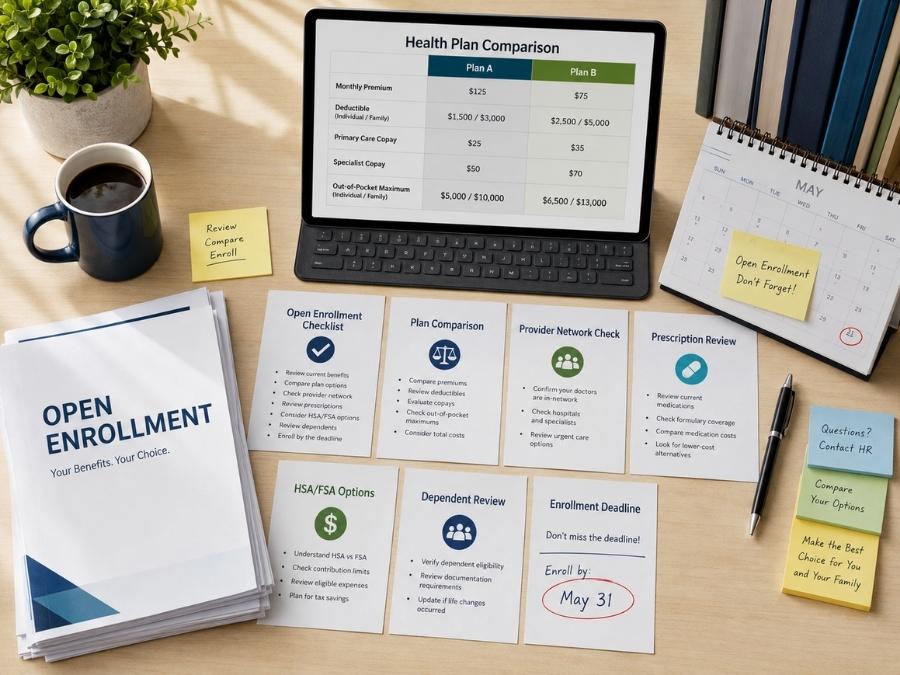
Employees need to compare the premiums, deductibles, copays, coinsurance, and out-of-pocket maximum together. Looking at only the paycheck deduction is like buying the cheapest used car on the lot without checking the engine.
A cheap plan is not always a bad plan.
But it is not automatically the cheapest plan in real life.
Mistake 2: Ignoring the Provider Network
Employees often assume their doctor is still covered.
That assumption causes trouble.
Provider networks can change. Doctors can leave a network. Facilities can be treated differently than physicians. A hospital may be in network while a specialist connected to that hospital is not. A plan that looked fine on paper can become frustrating fast when an employee realizes the provider they actually use is outside the network.
This matters even more when employees are choosing between HMO, PPO, EPO, or POS-style plans. Different plan types can affect provider choice and whether care outside the network is covered or costs more.
Employees should not ask, “Is this plan good?”
They should ask, “Does this plan work with the doctors, hospitals, clinics, pharmacies, and specialists I actually use?”
That is a much better question.
Mistake 3: Not Checking Prescription Drug Coverage
Prescription coverage is where employees get blindsided.
They choose a plan based on the premium and deductible, then find out later that a medication moved to a higher tier, requires prior authorization, has a step therapy requirement, or is not covered the way they expected.
That can get expensive quickly.
Employees who take regular medication should check the plan’s drug formulary before enrolling. Not after. They should confirm whether the medication is covered, what tier it falls under, whether generics are available, and whether mail-order pharmacy options change the cost.
This is not just for employees with complex medical needs.
A common medication can still be priced differently across plans.
Open enrollment is the time to find that out.
January is the expensive time to find that out.
Mistake 4: Repeating Last Year’s Choices Without Reviewing Changes
Autopilot is dangerous during open enrollment.
Employees often think, “I will just keep what I had last year.”
Sometimes that works.
Sometimes the plan changed.
Premiums may be different. Deductibles may be higher. Copays may shift. Prescription coverage may change. Provider networks may narrow. Employer contributions may be adjusted. HSA or FSA limits may change. Voluntary benefits may be added or removed.
The employee may also have changed.
New spouse. New baby. New medication. New diagnosis. New financial situation. New preferred doctor. New dependent turning 26. New plan priorities.
Last year’s decision may not fit this year’s life.
Open enrollment should not be treated like renewing a magazine subscription.
It deserves at least one real review.
Mistake 5: Forgetting to Update Dependents and Life Changes
This one sounds basic until it becomes a mess.
Employees forget to add a spouse. Remove an ex-spouse. Add a newborn. Update dependent information. Check whether a child is aging out. Review beneficiary designations. Confirm Social Security numbers or required documentation. Update addresses.
Then something happens.
A claim gets denied. A dependent is missing. A life insurance beneficiary is outdated. Someone discovers too late that the wrong person is still listed.
Open enrollment is not just about choosing a medical plan.
It is a chance to clean up the household file.
That is not exciting.
It is necessary.
Mistake 6: Underusing HSAs and FSAs
Many employees leave tax savings on the table because they do not understand HSAs and FSAs.
A Health Savings Account can be useful for employees enrolled in an HSA-eligible high-deductible health plan. It allows eligible employees to set aside money for qualified medical expenses with tax advantages. An FSA can also help employees use pre-tax dollars for eligible health expenses, but it usually has stricter election timing and spending rules.
That deadline matters.
Employees often miss it because FSAs feel optional.
Then they spend the entire year paying eligible expenses with after-tax dollars.
For employees with predictable costs like prescriptions, glasses, contacts, dental work, therapy copays, or regular appointments, an FSA or HSA can make a meaningful difference.
But they need to understand the rules.
Especially the “use it or lose it” nature of many FSAs.
Mistake 7: Not Understanding the Deductible
Deductibles cause more confusion than almost any other benefit term.
Employees may think that if they have insurance, most care is immediately covered. Then they realize they must pay the full negotiated cost for certain services until the deductible is met. That can feel like a nasty surprise, even when the plan is working exactly as designed.
A deductible is not the same thing as a premium.
A copay is not the same thing as coinsurance.
An out-of-pocket maximum is not the same thing as a deductible.
Employees do not need a benefits degree. But they do need a plain-English explanation of how money actually flows when they visit a doctor, fill a prescription, or have a procedure.
If employees do not understand the deductible, they are not choosing a plan.
They are guessing.
Mistake 8: Overlooking Voluntary Benefits
Voluntary benefits can be useful, but they can also clutter the decision.
Employees may ignore them completely because they are focused on medical coverage. Or they may overbuy because every benefit sounds important when presented in a polished enrollment packet.
Common voluntary benefits include dental, vision, accident insurance, critical illness coverage, hospital indemnity, supplemental life insurance, disability coverage, legal plans, pet insurance, identity protection, and more.
Some are valuable for the right employee.
Some are unnecessary.
The mistake is not choosing or skipping them.
The mistake is doing either without understanding the purpose.
A young employee with no dependents may not need the same life insurance decision as an employee with a spouse, children, and a mortgage. An employee with limited savings may value short-term disability more than someone with a large emergency fund. A person with regular eye care needs may care a lot about vision coverage.
Voluntary benefits should be matched to risk.
Not bought because the brochure looked serious.
Mistake 9: Missing the Deadline
Open enrollment has a deadline for a reason.
After it closes, employees generally cannot make changes until the next open enrollment period unless they have a qualifying life event. That may include things like marriage, divorce, birth or adoption, loss of other coverage, or certain other eligible changes.
This is where procrastination hurts.
Employees think they will come back to it later. Then the window closes. Now they are stuck with last year’s plan, no FSA election, missing dependents, or no voluntary coverage.
The employer can be sympathetic.
But sympathy does not always reopen enrollment.
That is why reminders matter.
Not one reminder.
Several.
Mistake 10: Asking Questions Too Late
Employees often wait until the final day to ask questions.
That is bad for everyone.
The employee feels rushed. HR gets flooded. The broker or benefits advisor may not respond instantly. Managers start guessing. Payroll deadlines get tight. Mistakes happen.
Open enrollment works better when employees are encouraged to ask early.
That requires employers to create space for questions before the deadline pressure hits. A short meeting, office hours, a FAQ sheet, a recorded walkthrough, or a simple “ask by this date” reminder can prevent a lot of chaos.
Employees do not need to become experts.
They need enough time and clarity to make a decent decision.
The Quick Scan List: 10 Errors to Predict
Use this as the quick scan list for employees and managers:
- Choosing the lowest monthly premium while ignoring total out-of-pocket exposure.
- Blindly assuming current doctors and hospitals are automatically still in-network.
- Skipping the annual prescription drug formulary and pharmacy tier check.
- Defaulting to autopilot and repeating last year’s elections without a review.
- Forgetting to add newborns, remove ex-spouses, or update beneficiary files.
- Leaving tax-advantaged money on the table by underusing HSAs or FSAs.
- Misunderstanding the difference between deductibles, copays, and coinsurance.
- Overlooking specialized voluntary benefits or overbuying unneeded coverage tiers.
- Letting the enrollment window slide past and missing the hard deadline.
- Waiting until the final 48 hours of the window to ask a foundational question.
None of these mistakes are unusual.
That is exactly why employers should plan for them.
If you already know where people get confused, do not wait for them to fall into the same holes again.
Open Enrollment Mistake Map
| Employee Mistake | What Usually Happens | How Employers Can Help |
|---|---|---|
| Choosing the cheapest premium | Employee ignores deductible, coinsurance, and out-of-pocket exposure. | Provide a total-cost comparison, not just premium charts. |
| Ignoring provider networks | Employee discovers later that a doctor, specialist, or facility is out of network. | Remind employees to verify providers before enrolling. |
| Skipping prescription review | Medication costs jump unexpectedly. | Share instructions for checking formularies and pharmacy tiers. |
| Repeating last year’s choices | Employee misses plan design, cost, or life changes. | Highlight what changed from last year. |
| Forgetting dependents | Spouse, child, or beneficiary information is wrong. | Include a dependent and beneficiary review reminder. |
| Missing HSA/FSA elections | Employee loses tax-saving opportunities. | Explain deadlines, contribution limits, and spending rules clearly. |
| Asking too late | HR gets flooded and employees rush decisions. | Set question deadlines and hold office hours early. |
This table is the whole job.
Open enrollment is not just about offering benefits.
It is about helping employees not misuse them.
How Employers Can Help Employees Avoid Open Enrollment Mistakes
The best open enrollment support is not fancy.
It is clear, early, repetitive, and practical.
Employees need simple explanations, not a benefits lecture. They need reminders that sound human. They need examples. They need to know what changed. They need a safe way to ask questions without feeling embarrassed.
A good open enrollment process should reduce confusion before it becomes payroll or claims drama.
That means employers need to stop treating open enrollment like a paperwork event.
It is a communication event.
The Employer Open Enrollment Support Checklist
Work through these ten structural steps in order before your next open enrollment window launches:
- Analyze what changed from last year.
Identify exact shifts in premiums, deductibles, networks, prescription coverage, employer contributions, carrier rules, and voluntary benefits. - Draft a plain-English benefits summary.
Translate insurance industry jargon into normal human language so employees can understand the real decision in front of them. - Build a total-cost comparison model.
Help employees look at paycheck premiums, deductibles, copays, coinsurance, and worst-case out-of-pocket maximums side by side. - Instruct staff to verify doctors and prescriptions.
Give explicit directions to run current provider, pharmacy, and drug formulary checks before submitting elections. - Host a brief, practical walkthrough meeting.
Explain the exact decisions employees must make, where to find forms, what changed, and who can answer questions. - Schedule dedicated Q&A time before the final week.
Give employees room to think before deadline pressure hits. - Deploy repeated, multi-channel deadline alerts.
Send reminders at launch, midpoint, one week out, and the final 48 hours. - Enforce a dependent and beneficiary audit.
Push employees to verify names, spelling, Social Security numbers, dates of birth, addresses, spouses, children, and life insurance beneficiaries. - Clarify what cannot be changed later.
Make sure employees understand that many elections lock for 12 months unless they experience a qualifying life event. - Document employee acknowledgments.
Keep clean, permanent records proving materials, deadlines, and instructions were received.
This is not overcommunication.
It is how you avoid the January parade of “I thought I picked something else.”
What Employees Should Compare on Paper
Employees do not need to become insurance experts, but they should compare the parts that actually affect their wallets.
That usually means:
- Monthly premium or payroll paycheck deduction
- Annual deductible floor
- Copays for common, routine doctor visits
- Coinsurance percentages after the deductible is met
- True annual out-of-pocket maximum ceiling
- Active provider network style, such as HMO, PPO, EPO, or POS
- Prescription drug formulary placement and medication tiers
- Specialist access restrictions and prior authorization rules
- Emergency care rules
- HSA eligibility
- Employer HSA contribution, if any
- FSA availability and rules
- Dependent coverage cost
- Expected medical needs for the year
This list is not exciting.
Neither is a surprise medical bill.
A little comparison during open enrollment can prevent a year of frustration.
The Total-Cost Decision Framework: Employee Version
Instruct your team to walk through these seven steps in exact chronological order before submitting their final elections:
- Determine the baseline cost.
Calculate exactly what will leave the paycheck through the monthly premium. - Forecast anticipated medical needs.
Account for planned surgeries, regular maintenance prescriptions, ongoing therapies, specialist visits, pregnancy, children’s care, or chronic conditions. - Verify active network alignment.
Check whether preferred doctors, clinics, hospitals, pharmacies, and specialists accept the new plan directly. - Confirm medication tier pricing.
Cross-check regular prescriptions against the plan’s current formulary, tier structure, prior authorization rules, and pharmacy options. - Model a worst-case scenario year.
Review the deductible, coinsurance, and out-of-pocket maximum to understand what could be owed in an emergency or high-care year. - Evaluate tax-advantaged accounts.
Decide whether an HSA or FSA makes financial sense based on expected cash flow and eligible expenses. - Clean up domestic file data.
Update spouses, dependents, contact details, addresses, Social Security numbers, and life insurance beneficiaries.
This is the employee version of “measure twice, cut once.”
It is much easier to review the plan now than fix the wrong election later.
Open Enrollment Communication Timeline
| Timing | Employer Action | Why It Helps |
| 3 to 4 weeks before launch | Confirm plan changes, rates, deadlines, and enrollment materials. | Prevents last-minute confusion before employees see the options. |
| Launch week | Send plain-English summary and enrollment instructions. | Gives employees enough time to review. |
| Midpoint | Send FAQ and reminder to check doctors, prescriptions, and dependents. | Catches the most common mistakes early. |
| One week before deadline | Hold Q&A or office hours. | Reduces last-minute panic. |
| Final 48 hours | Send final deadline reminder. | Helps prevent missed elections. |
| After close | Confirm elections and document acknowledgments. | Creates a clean administrative record. |
This does not need to be complicated.
It just needs to happen before employees are out of time.
How to Explain Benefits Without Sounding Like an Insurance Packet
Employees do not need more jargon.
They need translation.
Instead of saying, “Review your cost-sharing obligations under each plan option,” say, “Look at what you pay from your paycheck, what you pay before insurance starts helping, and the most you could owe in a bad year.”
Instead of saying, “Verify formulary tier placement,” say, “Check whether your prescriptions are covered and what they will cost.”
Instead of saying, “Confirm network participation,” say, “Make sure your doctor, hospital, and pharmacy still take this plan.”
That is not dumbing it down.
That is communicating like a person.
The benefits may be technical.
The explanation should not be.
Where Employers Should Be Careful
Employers can educate employees.
They should be cautious about making personal coverage decisions for themselves.
There is a difference between explaining how a plan works and telling an employee which plan to choose. Employers should give tools, examples, career resources, and access to brokers or benefits advisors where appropriate. They should not guess about an employee’s medical needs or tell them what is best for their family.
That boundary matters.
Say, “Here is how to compare the plans.”
Not, “You should pick this one.”
Say, “Here is where to check your doctor and prescriptions.”
Not, “I am sure you will be fine.”
Benefits decisions are personal.
Employer communication should be helpful without becoming careless advice.
Common Employer Mistakes During Open Enrollment
Employees are not the only ones who make mistakes.
Employers create confusion too.
Common employer mistakes include:
- Sending enrollment materials too late.
- Providing plan documents without plain-English explanations.
- Failing to explain what changed from last year.
- Letting managers answer benefits questions they are not trained to answer.
- Forgetting to remind employees about dependents and beneficiaries.
- Not explaining HSA or FSA deadlines clearly.
- Assuming employees understand deductibles and networks.
- Waiting until the final week to offer Q&A.
- Failing to document employee acknowledgments.
- Treating open enrollment like a one-time email instead of a process.
That last mistake is the big one.
One email is not a benefits communication strategy.
It is a timestamp.
The Bottom Line: Open Enrollment Is a Communication Test
The biggest employee mistakes during open enrollment are predictable.
People choose the cheapest premium. They forget to check the doctors. They ignore prescriptions. They miss tax-saving accounts. They repeat last year’s choices. They forget dependents. They wait too long.
That means employers have a chance to prevent many of the problems before they happen.
A good open enrollment process does not require fancy technology or a corporate HR department. It requires clear language, early reminders, practical comparisons, and enough room for employees to ask questions before the deadline hits.
The goal is not to make employees insurance experts.
The goal is to help them make fewer expensive guesses.
Next Step for Employers
Before your next open enrollment, pull the top five questions employees asked last year.
Then build your communication around those questions.
If employees were confused about deductibles, explain deductibles first. If they missed FSA elections, make that deadline impossible to miss. If they complained about doctors being out of network, put provider verification front and center.
Open enrollment gets easier when you stop writing for the benefits carrier and start writing for the employee who has 15 minutes between meetings to make a decision that affects their whole year.