What Are the First Five HR Policies Every Small Business Should Have in Place Before They Get Sued?
Quick Answer:
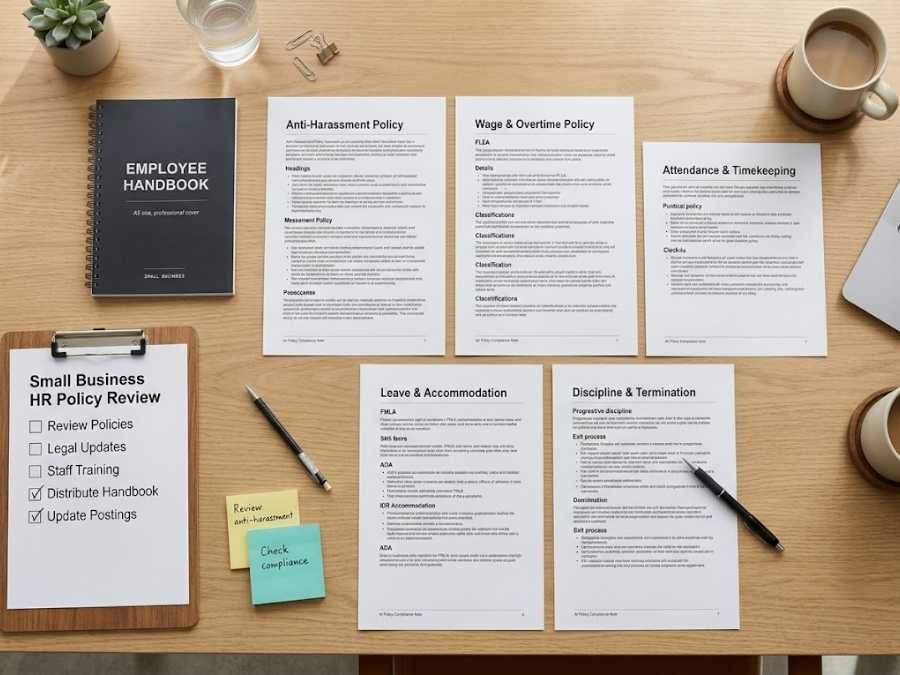
The first five HR policies every small business should have are an anti-harassment and anti-discrimination policy, a wage and hour policy, an attendance and timekeeping policy, a leave and accommodation policy, and a discipline and termination policy.
Those five policies cover the places where small businesses usually get burned: workplace conduct, pay, time records, absences, disability accommodations, and messy firings.
You do not need a 90-page corporate handbook on day one. You do need written rules that employees can understand and managers can actually follow. The goal is not paperwork for the sake of paperwork. The goal is to avoid the kind of “we never said that” argument that becomes expensive later.
Why HR Policies Matter Before There Is a Problem
Most small businesses do not start with HR policies.
They start with trust.
A few employees. A few verbal rules. A general idea is that everyone should act like adults and be reasonable.
That works for a while.
Then someone starts showing up late every Monday. Someone complains about a manager’s comments. Someone says they were promised overtime. Someone gets fired and claims nobody ever warned them. Suddenly, the owner is digging through text messages, payroll records, and half-remembered conversations, trying to prove what happened.
That is a terrible place to build your defense.
HR policies are not there because you expect the worst from people. They are there because memory is messy, managers are inconsistent, and employees deserve to know the rules before those rules are used against them.
A basic policy does not solve every problem.
But it gives the business a starting point when things get uncomfortable.
The Concrete Numbers Behind the Risk
This is not theoretical HR fear-mongering. Employment claims are common enough that small business owners should treat policies as basic business protection, not corporate decoration.
According to the EEOC’s FY 2024 enforcement data, the agency received 88,531 workplace discrimination charges. Retaliation was the most common charge category, appearing in 47.8% of charges. Harassment appeared in 40.4%, disability discrimination in 38.0%, race discrimination in 34.2%, and sex discrimination in 30.4%.
That matters because retaliation is often the claim that owners do not see coming.
An employee complains. The owner gets irritated. A schedule change. Hours get cut. The employee is suddenly treated like a problem. Even if the original complaint is weak, the retaliation claim can become the real lawsuit.
Then there is the cost.
Hiscox reported that in a study of small-to-midsize enterprises with fewer than 500 employees, 24% of employment charges resulted in defense and settlement costs averaging $160,000. The Hartford reports that, for businesses of all sizes, EPLI cases that settle average about $75,000, while defense costs average about $120,000 per claim.
Those are not numbers most small businesses can casually absorb.
One bad claim can eat the profit from a very good year.
The Small Business Mistake: Waiting Until the First Complaint
Here is how this usually goes.
A business hires its first few employees. Everyone knows everyone. The owner handles payroll, scheduling, complaints, discipline, hiring, and customer problems while also chasing invoices and trying to keep the lights on. Policies feel like something bigger companies need, not a five-person team trying to survive Tuesday.
Then the team grows.
Now there are 12 employees. Then 20. A supervisor gets promoted because they are good at the work, not because they know employment law. Someone has a medical issue. Someone wants schedule flexibility. Someone says another employee made them uncomfortable. Someone misses three shifts and says nobody ever explained the attendance policy.
Now the owner wants a policy.
The problem is, policies written after a conflict often look like damage control. They may still help going forward, but they do not erase what already happened.
The better move is simple.
Write the basic rules before you need them.
1. Anti-Harassment and Anti-Discrimination Policy
If a small business only writes one HR policy first, this is usually the one.
An anti-harassment and anti-discrimination policy tells employees what behavior is not acceptable, how to report concerns, who they can report to, and how the company will respond. It should cover harassment, discrimination, retaliation, bullying behavior, inappropriate comments, and conduct tied to protected characteristics such as race, color, religion, sex, pregnancy, national origin, age, disability, genetic information, and other categories protected by law.
This policy matters because harassment complaints do not always arrive as formal legal letters.
Sometimes they start as a quiet comment after a meeting.
“I don’t want to make a big deal out of this, but…”
That sentence should make every manager pay attention.
Sometimes the first report comes from a witness, not the person directly affected. Sometimes an employee makes a joke about quitting before they admit what is really happening. Sometimes the owner hears about it thirdhand and hopes it blows over.
Hope is not a process.
A good policy should not just say, “We do not tolerate harassment.” Every company says that. The useful part is the reporting path. Employees need more than one person they can report to, especially if the problem involves their direct supervisor.
What This Policy Should Include
A small business anti-harassment and anti-discrimination policy should include:
- Clear examples of prohibited conduct
- A statement banning retaliation
- A statement banning retaliation
- Multiple reporting options
- A basic investigation process
- Confidentiality language, without overpromising secrecy
- A statement that violations may lead to discipline or termination
- A reminder that managers must report complaints they receive
The retaliation piece matters more than many owners realize. Employees often stay quiet because they fear being punished, ignored, scheduled less, treated differently, or pushed out.
A policy that does not address retaliation is missing one of the biggest reasons complaints turn into legal claims.
Consultant Note: Train the Managers, Not Just the Employees
A policy sitting in a handbook will not save a business if managers ignore it.
Managers need to know what counts as a complaint, what to do when they hear one, and what not to say in the moment.
“Are you sure you want to report that?” is the kind of sentence that can look terrible later.
So is, “That is just how he jokes.”
Small businesses often promote their best worker into management and assume common sense will carry the rest.
It usually does not.
2. Wage, Overtime, and Pay Policy
Pay disputes are where small business informality gets expensive fast.
A wage and hour policy should explain how employees are paid, how overtime works, how time is recorded, when paydays happen, how meal and rest breaks are handled where applicable, what deductions may occur, and who employees should contact if they believe their paycheck is wrong.
This is not glamorous HR work.
It is also one of the most important parts of staying out of trouble.
The biggest mistake is assuming pay rules are obvious. They are not. Hourly employees need clear timekeeping rules. Nonexempt employees need to know they cannot work off the clock. Managers need to know they cannot casually ask someone to “just finish this after clocking out.”
And salaried employees need to be classified correctly.
Not just called salaried because it feels cleaner.
The Pay Problems That Cause Lawsuits
Here is where small businesses get hit most often:
Employees working before clock-in or after clock-out
Missed overtime
Misclassifying workers as exempt salaried employees
Treating employees as independent contractors when they are not
Rounding time unfairly
Paycheck deductions that violate law
No clear process for reporting pay errors
A business does not need fancy language here. It needs clarity. Employees should know exactly how to record time, when overtime must be approved, and what to do if their paycheck looks wrong.
The Blunt Rule
If an hourly employee works, they generally need to be paid.
Even if the overtime was not approved.
Even if the manager did not want them working.
Even if the employee “volunteered” to finish something quickly.
You can discipline someone for violating an overtime approval policy. But you generally cannot refuse to pay for work you allowed or knew about.
That distinction matters.
Payroll becomes evidence very quickly.
3. Attendance, Scheduling, and Timekeeping Policy
Attendance issues are where resentment grows quietly.
One employee is late every Monday. Another calls out with no notice. Another keeps switching shifts by text without telling the manager. The reliable employees notice. The manager gets frustrated. The owner waits too long because they do not want conflict.
Then the business finally disciplines someone, and the employee says, “Nobody told me that was the rule.”
That is why an attendance and timekeeping policy belongs in the first five.
This policy should explain work hours, scheduling expectations, call-out procedures, lateness, no-shows, time clock rules, shift changes, remote work expectations if applicable, and what happens when attendance problems continue.
It should be practical.
Not punitive for the sake of sounding tough.
Practical.
What This Policy Should Include
An attendance and timekeeping policy should answer basic questions:
When is an employee considered late?
Who do they notify if they will be absent?
How much notice is required when possible?
What happens after a no-call, no-show?
How are shift changes approved?
Can employees trade shifts?
How should remote or hybrid employees track time?
What happens if someone forgets to clock in?
If the business uses scheduling software, say so. If call-outs must go to a manager and not a coworker, say so. If texting is acceptable, define where and to whom. If it is not acceptable, say that too.
Small businesses often think these details are too obvious to write down.
They are not obvious when someone is angry.
Policy vs. Real Life
Be careful not to write an attendance policy so rigid that it ignores protected leave, disability accommodation, sick leave laws, pregnancy limitations, or emergencies.
Attendance rules matter.
But they cannot be applied blindly.
That is where owners get into trouble. They discipline someone for absences without realizing the absences may involve a medical condition, pregnancy, disability, workplace injury, domestic violence leave, protected sick time, or another legally protected reason.
The attendance policy should work alongside the leave and accommodation policy.
Not against it.
4. Leave, Sick Time, and Accommodation Policy
This is the policy that small businesses tend to postpone until someone gets sick.
That is too late.
A leave and accommodation policy explains what employees should do when they need time away from work or an adjustment to their job because of illness, injury, disability, pregnancy, family obligations, military service, or another protected reason. Depending on the size and location of the business, different federal, state, and local rules may apply.
Smaller businesses may not be covered by every federal leave law. That does not mean they can ignore leave issues. Disability accommodation laws, pregnancy accommodation rules, state paid sick leave laws, workers’ compensation, and local ordinances may still matter.
This is where small employers get surprised.
They assume, “We are too small for that.”
Sometimes they are.
Sometimes they are not.
And sometimes the issue is not the federal rule they were thinking of, but a state or local one they never checked.
What This Policy Should Include
A practical leave and accommodation policy should explain:
How employees request leave
Who handles leave requests
What documentation may be required
How paid time off interacts with unpaid leave
How benefits are handled during leave
How employees communicate during extended absences
How return-to-work is handled
How accommodation requests are reviewed
The accommodation piece is important. Employees do not always use legal language. They may not say, “I am requesting a reasonable accommodation under the ADA.”
They may say, “My doctor says I cannot lift more than 20 pounds for a while.”
Or, “I need a different schedule during treatment.”
Managers need to recognize that those statements may trigger a process.
The Real-World Risk
The danger is not just denying leave.
The danger is inconsistency.
One employee gets flexibility because the owner likes them. Another employee gets written up for a similar issue because the manager is annoyed. One person’s medical note is accepted. Another person’s is questioned aggressively. One employee is allowed to work from home during recovery. Another is told the company does not “do exceptions.”
That kind of inconsistency is exactly what turns an HR decision into a claim.
Fair does not mean every employee gets the exact same answer.
It means the business follows a consistent process and can explain its decision without sounding like it made the whole thing up that morning.
5. Discipline, Performance, and Termination Policy
Firing someone is rarely where the problem starts.
It is where the problem becomes visible.
Most termination disputes begin weeks or months earlier, when performance problems were ignored, warnings were vague, documentation was missing, or managers used different standards for different people. By the time the employee is fired, the owner wants the file to tell a clean story.
Often, it does not.
A discipline and termination policy gives the business a framework. It should explain that the company may use coaching, written warnings, performance improvement plans, suspension, or termination depending on the situation. It should also preserve the company’s ability to act immediately in serious cases.
Do not promise a rigid step-by-step process unless you are prepared to follow it every time.
That is a common mistake.
What This Policy Should Include
A useful discipline and termination policy should include:
Examples of conduct that may lead to discipline
A statement that discipline depends on the severity of the issue
A process for documenting performance concerns
Manager responsibility for timely feedback
A reminder that serious misconduct may lead to immediate termination
Final paycheck and property return procedures
At-will employment language, where legally appropriate
The at-will language matters, but it is not a magic shield. A business can still create risk if it fires someone for an unlawful reason, applies rules inconsistently, retaliates after a complaint, or ignores protected leave and accommodation issues.
In other words, “at-will” does not mean “say whatever you want and hope for the best.”
The Documentation Problem
Small business owners are often too nice for too long, then too harsh too suddenly.
They let problems slide because they do not want to hurt someone’s feelings. Then the frustration builds. Then one bad day happens, and the employee is fired with almost no written record of what led up to it.
That is risky.
Documentation does not have to be dramatic. A short written note after a coaching conversation can help. A clear email summarizing expectations can help. A signed written warning can help.
What matters is that the record reflects what actually happened and shows the employee had a chance to understand the problem.
The Five-Policy Risk Map
| Policy | What It Helps Prevent | Where Small Businesses Usually Slip |
|---|---|---|
| 1. Anti-Harassment & Discrimination | Workplace harassment, hostile environments, and retaliation claims. | Lacking an alternative reporting path; managers casually brushing off initial “quiet” complaints. |
| 2. Wage, Overtime, & Pay | Unpaid wage disputes, off-the-clock claims, and misclassification. | Allowing unapproved off-the-clock work or misclassifying hourly staff as salaried “exempt.” |
| 3. Attendance & Timekeeping | Inconsistent scheduling discipline and messy time-record disputes. | Relying on casual text-message call-outs and letting sloppy time tracking skate by. |
| 4. Leave & Accommodation | FMLA/ADA interference claims and perceived retaliation. | Treating complex medical absences or pregnancy limitations as standard attendance problems. |
| 5. Discipline & Termination | Costly wrongful termination claims and discrimination lawsuits. | Firing employees out of sudden frustration with zero clear, written, historical documentation. |
This table is the whole point.
HR policies are not paperwork for the sake of paperwork. They are the structure that keeps everyday management decisions from becoming expensive stories later.
Do You Need an Employee Handbook?
Eventually, yes.
But if the business is still small, do not let the idea of a full handbook become the excuse for having nothing. Start with the five policies that carry the most risk. Then build out the rest: technology use, social media, remote work, confidentiality, workplace safety, expense reimbursement, benefits eligibility, company property, complaint procedures, and required notices.
A handbook should not be copied blindly from the internet. State law matters. Industry matters. Company size matters. A restaurant, contractor, dental office, marketing agency, and warehouse should not all have the same exact handbook.
Templates are starting points.
Not legal armor.
The Policy Is Only as Good as the Manager Using It
Here is the uncomfortable part.
A policy does not protect a business if the manager ignores it.
If the handbook says complaints should go to HR, but the business has no HR person, employees will not know what to do. If the policy says overtime must be approved, but managers quietly encourage after-hours work, the policy is not doing much. If the policy promises fair treatment, but the owner disciplines one employee and excuses another for the same conduct, the paper trail will not save the business.
Implementation matters.
That means managers need training. Not a week-long seminar. Just practical instruction.
What do they do when someone complains? What do they document? When do they call the owner? When do they stop talking and get help?
A little training upfront is cheaper than a deposition later.
The Bottom Line: Write the Rules Before You Need Them
The first five HR policies every small business should have are not complicated because they are fancy. They are important because they cover the messy parts of employing people: behavior, pay, attendance, leave, and termination.
That is where lawsuits usually start.
Small businesses do not get sued because they lack corporate polish. They get sued because expectations were unclear, managers improvised, records were missing, and employees felt they were treated unfairly. Written policies will not prevent every claim. But they make it much easier to show that the business had rules, communicated them, and tried to apply them consistently.
That matters.
Especially when the alternative can cost tens of thousands of dollars before anyone even gets to trial.
Next Step for Owners
Pull your current employee handbook, onboarding packet, or offer letter. If you cannot find clear policies for harassment and discrimination, wage and overtime rules, attendance and timekeeping, leave and accommodation, and discipline or termination, that is your starting point.
Then look at your last 12 months.
Did anyone complain about a manager? Did anyone dispute pay? Did anyone have attendance problems? Did anyone request leave or schedule flexibility? Did anyone quit angry or get fired without much documentation?
Those are the places to fix first.
Do not wait until the first complaint to write the rule you wish you already had.